Unless it can credit President Trump for lowering them, the Media Research Center is not going to blame him for high gas prices due to his war on Iran. An April 16 CNS propaganda piece by Craoit Bannister uncritically repeated a distraction from them:
“We’ll keep this factual and review your actual record, not your reboot,” an oil and gas trade group told Kamala Harris, responding to her video blaming President Donald Trump for high gas prices during a time of war.
In a video posted to social media during her visit to North Carolina Wednesday, Harris complains that the cost of a tank of gas has increased $15 “since the start of Trump’s war of choice.” In the background is a gas station sign showing a price of $3.97 a gallon.
Replying to Harris’ video on X.com, the US Oil & Gas Association reminded Harris of how she defended the high cost of gas as vice president during the Biden Administration when the Russia-Ukraine war spiked prices:
[…]The US Oil & Gas Association’s post goes on to list the ways Harris, in her past roles as senator and California attorney general, forced gas prices higher, such as co-sponsoring the Green New Deal, working to ban oil extraction via fracking, and repeatedly suing oil and gas producers.
“You even sued the Obama-Biden administration to block new offshore permits off California’s coast,” the post reminds Harris.
“The lawfare you pursued laid the foundation for the collapse of the California refining industry we are witnessing right now,” the trade group notes. “California still pays the nation’s highest gas prices — thanks to the taxes, mandates, and anti-production policies you championed for years.”
Bannister did not explain how, exactly, these actions can be directly linked to direct actions by Harris.
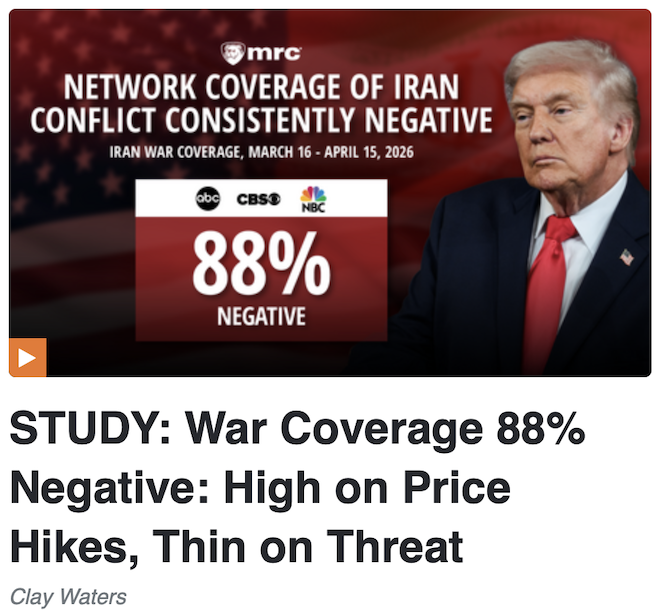
Clay Waters peddled the Trump Regime Media take on Trump’s war in an April 28 post:
On February 28, the United States and Israel unleashed Operation Epic Fury, a coordinated combat operation against a radical Iranian regime which has threatened America for decades, terrorizing its neighbors and even massacring its own people. President Donald Trump explained his war reasoning in a Truth Social post, citing the historical context of the dangerous regime and insisting “this terrorist regime can never have a nuclear weapon.”
As the war progressed, the three major broadcast networks insisted the Trump administration was on the backfoot, both at home and over the battlefield, mired in muddled messaging (despite Trump’s consistent emphasis on denying Iran nuclear weapons) and rising prices, while severely underplaying U.S. military success and barely noting the danger the Iranian regime posed to its neighbors and the world.
[…]Network evening news coverage was decidedly non-triumphal, with little emphasis on the global danger Iran’s nuclear program posed. Instead, the rise in U.S. gas prices was rendered in forensic detail in a nightly drumbeat. Prices were not just high, but “sky high,” which translated into “pain at the pump” and “economic turmoil,” directly linked to when “Trump started the war.”
Waters refused to explain why he thinks higher gas price should not be covered beyond that doing so makes Trump look bad.
Steve Malzberg played defense for Trump on high prices in a May 13 post:
On Tuesday The Bureau of Labor Statistics reported that inflation in April had risen 3.8% from last year, the highest level since May of 2023, and as President Trump took questions from the press before leaving the White House headed to China, he was asked about his negotiations with Iran, and if Americans paying higher prices was a motivating factor to make a deal.
We are at war, so his response, which was basically, I don’t think about that, could be viewed as insensitive by those who were not provided with the full question to him, and as you might expect, most of the nightly network newscasts did not present that complete question.
The President was asked, “When you are negotiating with Iran, Mr. President, (to) what extent (are) Americans’ financial situations motivating you to make a deal? The CBS Evening News probably did the worst job in presenting the story fairly, with Correspondent Kelly O’Grady handling the honors.
[…]Over on ABC’s World News Tonight, Chief Business Correspondent Rebecca Jarvis offered only a slightly more honest job in her introduction to the Trump clip with, “President Trump rejecting the idea that the pain Americans are feeling from inflation will influence his negotiations with Iran.”
Again, the actual question to Trump could have been played but wasn’t. However, unlike CBS‘s O’Grady, she did provide some context to the President’s statement.
[…]The PBS NewsHour had a great opportunity and blew it. Correspondent Stephanie Sy presented a social media post from a high-level Iranian official, which proves that Trump’s answer to the reporter’s question is the only answer that a leader in his position can give.
[…]She then totally misrepresented the question asked to the President, “The President was asked about the rising prices outside the White House.”
No, no, no. Again, he was asked, “When you are negotiating with Iran, Mr. President, (to) what extent (are) Americans’ financial situations motivating you to make a deal?” And he gave the only answer that he should and could give being that we are at war, and as the Iranian Speaker’s post indicates, our enemy is well aware of this issue. Unfortunately, the nightly newscasts, for the most part, seemed more interested in making Donald Trump look bad. No real surprise.
Joseph Vazquez similarly tried to con-splain oil and gas prices in a May 26 post:
Apparently, CNN has one-upped the experts on energy markets. They’re claiming, based on current price fluctuations, that we won’t see oil dip below $70 a barrel until — get this — 2032.
CNN Business Senior Reporter David Goldman — who’s become notorious for publishing some of the dumbesteconomic hot takes on the CNN website — joined the May 26 edition of CNN’s The Situation Room to put a face to the wild-eyed, logically derelict anti-Trump screeds he gets paid to write.
“There’s a huge amount of time that it’s going to take according to the futures market before we get back down to that sub-$70 oil level — look at this — 2032,” Goldman bloviated with certainty to anchor Pamela Brown, like he just struck black gold on the research front. He sneered further: “So, you want $3 gas again?You’re going to have to wait maybe six years,” which also conveniently means two presidential cycles. How does he know this? Eh, market vibes! Yes, vibes are what’s driving Goldman’s doom porn.
Holy BP Oil Spill! This is like promising we won’t see 70-degree weather again for the next six years. Oil markets don’t work that way — and unless CNN has completely lost the economic plot, their TV flunkies know this too. Even Brown responded with a flabbergasted “What?!” in disbelief at Goldman’s argument: “I’m sorry, did I hear you correctly? Did you say 2032?”
Goldman chuckled nervously then walked back his claim into a hedge by pointing to a Brent Oil Futures chart and throwing the assertion off of himself, “This tells you what the oil market is predicting prices will be in the future … That’s the prediction. We’ll see if that ends up being the case.”
As anybody with two brain cells and a cursory understanding of energy markets knows, there’s absolutely zero way to reliably project oil prices years out. That’s because the sector is extremely volatile and is subject to change drastically from day-to-day based on a multiplicity of factors.
Vazquez, however, didn’t dispute the fact that Trump’s war has raised oil and gas prices. Meanwhile, Vazquez was quick to tout dropping gas prices in a June 30 post:
CNN is slowly realizing it stepped on a rake when it chose to cry Apocalypse! for months to spook Americans about prices going to the stratosphere because of the Strait of Hormuz chaos.
CNN Business economics reporter Elisabeth Buchwald published a piece on June 25 with a headline that said the quiet part out loud: “Inflation topped 4% in May, but the worst may be over.”
Wait! So in other words, all that CNN crystal “bull” about oil not seeing $70 prices again until 2032 could have potentially just been a load of mindless media dreck? Perish the thought!
Buchwald chose to shoehorn some common sense into the economic debate, underscoring why the media’s fixation on volatile energy prices artificially inflated by war jitters didn’t comport with reality. “But when stripping out gas and food prices, two of the most volatile components tracked, so-called core inflation rose at a much more muted annual rate of 3.4% from 3.3% in April.”
Again, Vazquez didn’t dispute that Trump caused gas prices to rise — and he didn’t make a point of returning to the subject when gas prices rose again later in the summer.