The Media Research Center has had a long, partisan history with polls — loving them when they support its preferred (right-wing) candidates and narratives, denouncing them when they don’t, and even buying its own skewed polls to push those preferred narratives. Unsurprisingly, that pattern has continued during the new Trump era:
- In his Jan. 29 column, Tim Graham insisted that it was “bad news” at CNN when Trump showed positive polling results after the first few days of taking office, huffing that “Journalists may focus too intensely on opinion polls in between elections. When Republicans win, they’re very attentive to GOP poll ratings sinking.”
- Curtis Houck similarly groused in a Feb. 10 post that “ABC’s Good Morning America and NBC’s Today saw no reason amid their latest hyperventilating about President Trump fulfilling a campaign promise of shrinking the size of government — and that doing so has triggered ‘a constitutional crisis’” — to note a CBS poll showing his approval at a record 53 percent.”
- In a Feb. 13 post, Mark Finkelstein complained that it was predicted that “Democrats would score gains in the midterm elections and in the 2028 presidential election” — a fairly safe prediction given that the party in power almost always loses congressional seats in the midterms — despite current polling showing higher unfavorability.
Graham spent his March 5 column grousing that pollsters weren’t asking questions that make Trump look good:
The national media pay for national polls to measure public opinion. But often, they aren’t just measuring public opinion. Their selection of polling questions carries an agenda, and tests how the liberal media arguments are faring in all 50 states. Their questions change depending on which party’s president is in the White House.
There are generic measurements – the president’s approval rating, right-direction or wrong-direction. But pay attention to the ones that change with “the times.”
This week, PBS and NPR are promoting their latest poll with Marist University. They devoted special attention to this question: “Since taking office, Trump has (A) rushed to make changes without considering their impact or (B) Done what’s needed to get government back on track.”
The anti-Trump media have certainly pushed the angle that Trump’s attempts to cut the federal work force are horrible and chaotic. The poll by the taxpayer-funded networks found 56 percent agreed Trump has rushed it without considering everything, while 43 percent said he’s doing what’s needed.
[…]Public opinion isn’t so much asking the public what they think. It feels more like they’re telling them what they should think with the tilt of their questions.
Jorge Bonilla used an April 27 post to hype a Trump administration official supposedly “school[ing]” a TV host about polling:
Treasury Secretary Scott Bessent sat down with ABC’s Martha Raddatz for This Week, to talk tariffs, China, and trade. And Raddatz got more than she bargained for when she tried to corner Bessent with polling numbers.
[…]She never could get past Bessent’s shutdown of her original attack: the polls. And he’s right: much of the economic sentiment and narrative, as was the case during President Donald Trump’s first term, is media-driven.
Bonilla whined more about poll questions he doesn’t like in an April 29 post that was part of his employer’s whining that non-right-wingers weren’t sufficiently laudatory of Trump’s first 100 days in office:
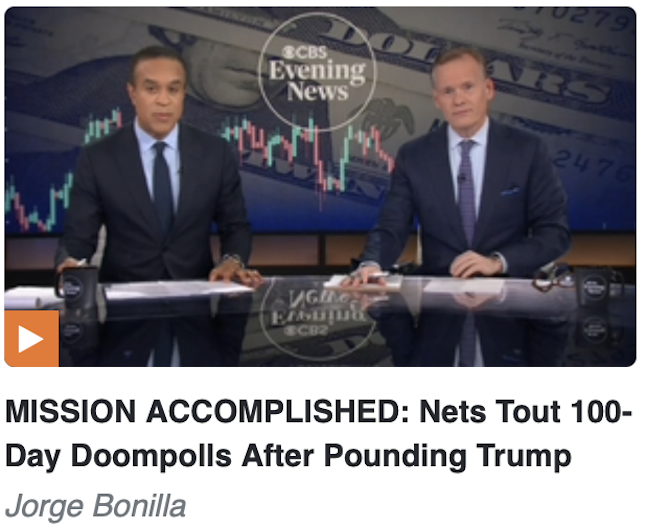
What does 92% negative coverage of President Donald Trump’s second term get you if you’re the legacy media? After the first 100 days, a basis from which to elicit doompolls that peddle narratives of disarray and chaos, while instilling fear in viewers.
Of these, CBS Evening News was demonstrably and by far the worst. Watch as their poll coverage begins with inflammatory language, to wit: John Dickerson alleging that trade war is a Trump economic policy, and with correspondent Janer Shamlian’s report shamelessly evoking the specter of the Great Recession of 2008:
[…]Each of the networks relied on terrible public polling with divergent results. The common ground: the polls were of “adults”, not registered or likely voters. In NBC’s case, 40% of respondents didn’t even vote in the 2024 presidential election. Of those polled who did, only 30% voted for Trump, as opposed to the 49.8% of actual voters who did so in the election.
Let these garbage polls and their horrendous coverage thereof remind us of the words of the great Rush Limbaugh, gone but never forgotten:
The polls are just being used as another tool of voter suppression. The polls are an attempt to not reflect public opinion, but to shape it. Yours. They want to depress the heck out of you.
Bonilla failed to disclose that his employer his its own notable history of buying polls from biased right-wing pollsters designed to shape public opinions toward its preferred narratives.
Graham returned to do his Trump Regime Media duty in a May 23 post insisting that Trump is doing better in polling that non-right-wing media will admit:
The national media use polls the way they deploy all kinds of facts. They very carefully organize things to make it look like their worldview is winning. Throughout these first months of the second term, they’ve presented Trump’s actions as chaotic and (they hope) politically damaging to Republicans.
So they may not notice polls that offer some good news. Let’s take the Real Clear Politics average of polls on whether the country’s going in the right or wrong direction. The numbers are more positive than anyone watching the networks would expect. It could be defined as voters stiff-arming the relentless media negativity.
[…]It could also be argued that no one should need an opinion poll for at least the first six months of a new presidential term. But this is one way that the media tries to intimidate Republicans out of passing policies they hate. “Oh, you’re sinking in the polls!” When the polls don’t look grim, they’ll likely be skipped, like this.
Graham didn’t discuss his employer’s history of buying polls or how often he and his fellow MRC workers ignore polls they don’t like.