In January, it was revealed that the right-wing Heritage Foundation would start targeting editors at the volunteer-edited Wikipedia for making edits it didn’t like. Shortly thereafter, the Media Research Center started targeting Wikipedia and its editors for ignoring right-wing media, as Luis Cornelio ranted in a Feb. 3 post:
Hoping to avoid misinformation about President Donald Trump’s nominees and appointments on Wikipedia? Good luck. Wikipedia has designed a protocol that directly and unerringly produces the worst descriptions about conservatives and Republicans by virtually guaranteeing that right-leaning media sources cannot be cited. The once reliable online encyclopedia ran off the rails under the leadership of its previous CEO Katherine Maher, who made sure that not a single right-leaning outlet was deemed “reliable”—a stark contrast to the 84 percent of leftist media Wikipedia deems reliable.
A new study by Media Research Center Free Speech America found that Wikipedia, the encyclopedia behemoth, has effectively blacklisted all right-leaning media from being used as source material, exclusively relying on leftist, legacy media notoriously known to spread misinformation and attack opponents of the left.
Among the effectively blackballed media sources are Breitbart, The Daily Caller, Daily Mail, Newsmax, OANN and the Media Research Center. Meanwhile, leftist media like The Atlantic, Jacobin, Mother Jones, Pro-Publica, The Guardian and National Public Radio (NPR) are given the green light. This blatant misinformation means that Wikipedia is purposely feeding Americans information exclusively through the lens of one side of the political spectrum—the left.
Positioning themselves as arbiters of truth, Wikipedia and its editors have effectively institutionalized a blacklisting system utilizing a “Reliable sources/Perennial sources” page that forbids the use of some of the most popular media sources on the right when editing Wikipedia pages. Their claims? Right-leaning sources are not “reliable,” and in some cases literally “blacklisted” — Wikipedia’s actual word — from use on the platform altogether. The predictable effect? Conservatives, Republicans and Trump appointees are smeared, maligned and slandered by the most popular online source for information about people.
Such a blockade has resulted in a disparate balance that disturbingly disadvantages right-leaning media: Wikipedia effectively blocks 100 percent of right-leaning media sources – the ones more likely to give fair treatment to the majority in Congress as well as to incoming officials to the Trump administration. On the contrary, only 16 percent of left-wing media sources fail to win Wikipedia’s stamp of approval.
Despite offering no evidence those right-wing outlets are reliable and baselessly insisting that the only possible reason for the ban on those outlets involves partisan politics — no effort was made to allow Wikipedia to respond to this attack — Cornelio huffed that his employer’s bias was also questioned:
For instance, the Media Research Center and its flagship media subdivisions—MRCTV.org and NewsBusters—are dubbed “generally unreliable” because some Wikipedia editors “believe these sources publish false or fabricated information.”
Since its founding in 1987, not one MRC study—whether it is uncovering bias in cable news or exposing Big Tech election interference—has been proven false or fabricated.
In fact, we have repeatedly documented how numerous MRC “studies” ignore most media sources in order to paint a tiny sliver of them as having a “liberal bias” while repeatedly ignoring the indisputable right-wing bias of outlets such as Fox News. Such studies tend to be based on subjective concepts of “spin” rather than actual bias and appeared skewed to always find the “liberal bias” it has built a multimillion-dollar organization out of seeking. Cornelio further demonstrated his own bias by repeatedly describing non-right-wing media sources as “leftist” while referencing right-wing media as merely “right-leaning.”
Instead, Cornelio ranted that “Wikipedia’s blacklisting system is not a random occurrence, as it appears to echo the vision of current NPR President and CEO Katherine Maher, the radical leftist who was previously the chief executive officer of the Wikimedia Foundation.” He offered no evidence to justify his assertion that Maher is a “radical leftist.”
Tom Olohan grumbled in a March 19 Free Speech America post that Wikipedia pages about Trump administration officials weren’t solely right-wing propaganda:
Shortly after President Donald Trump announced key cabinet nominees, Wikipedia editors changed their pages in an apparent attempt to highlight damaging information. The editors appear to have carefully timed these cunning changes to be made during the lead-up to the confirmation process when the Trump nominees were under the microscope.
The infamously biased online encyclopedia substantially altered its entries for now-Secretary of Defense Pete Hegseth, now-FBI Director Kash Patel and now-Director of National Intelligence Tulsi Gabbard. The Wikipedia page for Russell Vought, Trump’s nominee for director of the Office of Management and Budget, was also impacted. MRC Free Speech America compared the last archived versions of each nominee’s Wikipedia entry before Trump announced their nominations versus archived pages after their nominations.
The changes made by Wikipedia were significant, including:
- Manufacturing entirely new negative sections on the nominees’ pages.
- Overhauling nominees’ “Personal life” sections.
- Changing the characterization of incidents described.
- Substantially increasing existing coverage of controversial material/events.
Wikipedia, one of the most visited websites in the world, appears on the first page of 99 percent of Google searches and is the number one result for a majority of all searches, according to Search Engine Watch. This is likely a direct result of Google frequently using Wikipedia as a source for its “knowledge panels,” which often appear at the top of many basic online searches. This was the case in Google searches for each of the nominees that MRC researchers included in this study.
Olohan offered no evidence that any of the changes were factually incorrect, or that any information that might actually have been false was not corrected, or that Wikipedia is “infamously biased.” Instead, he whined:
Wikipedia doesn’t just target the right. It also coddles its political allies. Wikipedia editors allowed 116 edits to the online encyclopedia’s “recession” page, apparently to avoid embarrassing the Biden-Harris administration with clear evidence of their Bidenomics disaster.
Olohan offered no evidence to back up his assertion that Bidenomics was a “disaster.” We’ve previously noted the MRC blaming a George Soros conspiracy on recession-related changes at Wikipedia, as well as the MRC’s own attempts to redefine what a recession is to attack the Biden administration.
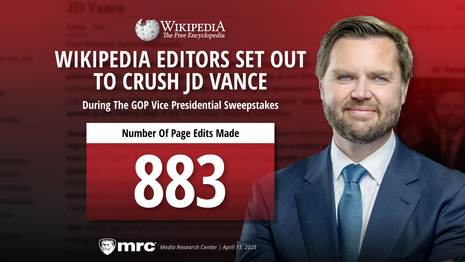
It took both Olohan and his boss, Dan Schneider, to huff in an April 17 post that Wikipedia’s page on Vice President J.D. Vance wasn’t all right-wing propaganda:
MRC Free Speech America previously exposed Wikipedia editors for meddling with the pages of Pete Hegseth, Tulsi Gabbard and Kash Patel. Vice President JD Vance wasn’t spared poor treatment either.
Wikipedia editors piled on negative content to Vance’s page right after major political developments—including when President Donald Trump named him his running mate, and after the infamous U.S. Supreme Court decision in Dobbs v. Jackson Women’s Health Organization.
Asserting that “MRC’s findings are striking,” Olohan and Schneider served up its own biased so-called evaluation. Here are some actual bullet points:
- Wikipedia Editors Set Out to Crush JD Vance Right When He Became a Potential Vice Presidential Candidate.
- Wikipedia Effectively Framed Vance as a Radical Across Key Issues.
- Ill-Treatment of Vance Began after He Launched His GOP Senate Candidacy.
They went on to complain:
In summary, the editors responded to Vance’s run for office by mauling a page that had scarcely any negative material beyond a few criticisms of Hillbilly Elegy to counter-balance its glowing reviews. The online encyclopedia editors targeted apparent vulnerabilities, added to existing attacks and smeared Vance with fresh nonsense.
Olohan and Schneider did not explain how the purportedly negative treatment of Vance was any different from any other person who went from relative obscurity as an author into big-league politics asn a senator and then vice president.