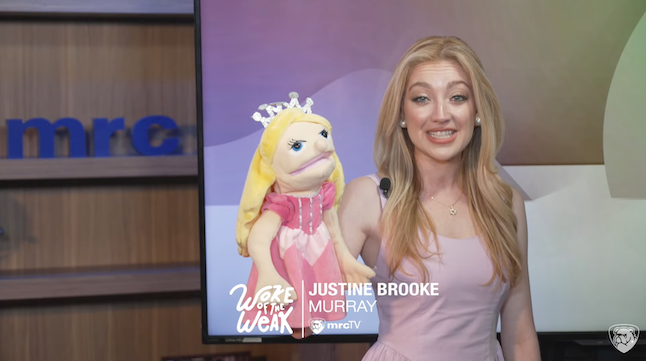
The Media Research Center thinks this unhinged June 11 screed by Justine Brooke Murray is sufficient evidence to get Congress to defund public broadcasting:
Sexually confusing four year olds under the guise of “free, children’s programming” is now leveraged as an emotional and touching argument against cutting out of touch PBS and NPR propagandists off the taxpayer teet.
The government warriors at PBS are still desperately banking on their half-baked idea to pull at American heartstrings by marching out Cookie monster and his furry comrades for mercy, as if they’re about to be shot.
Questioning why you should continue sponsoring left-wing media bias, therefore, brands you a muppet murdering monster!
But there’s just one thing the network conveniently continues to leave out: Sesame Street hasn’t been under their jurisdiction for ten years. First they worked for HBO, and they’re now Netflix’s problem!
That makes PBS and the muppets as honest as their hobo doppelgangers following you to the Manhattan subway in used fursuits with the promise of a “free” picture!
It’s why Congress will soon vote to free Americans of their taxpayer-funded lies.
The “Sexually confusing four year olds” stuff is apparently because PBS had a drag queen on TV one time. That violates the MRC dictate that transgender people and drag queens are not allowed to be on TV in any form. Murray identified no “taxpayer-funded lies” that have been spread by public broadcasting, though we have documented falsehoods she has committed. (She also misspelled “teat.”)
It’s also interesting that Murray makes a big deal out of ‘Sesame Street” having a deal with Netflix, because we caught her getting that wrong too.
Alex Christy groused that someone defended PBS in a June 12 post:
MSNBC’s Ana Cabrera grew up in the 80s, and the media landscape has changed a lot since then, but on her Thursday show, she implied her family’s inability to pay for cable as a child means Congress should not approve President Trump’s rescission package that seeks to defund PBS and NPR.
[…]In reality, PBS and NPR are in the rescission package because they have spent decades running afoul of their legal mandate to be neutral in their news coverage. Nevertheless, Cabrera concluded, “My family could never afford cable growing up. And I remember watching Sesame Street and Mister Rogers, too. Fine memories of that as a child. Congressman Brendan Boyle, thank you for joining us. I appreciate it.”
Sesame Street was recently purchased by Netflix, but one reason why PBS has to partner with a private company—previously it was HBO—to produce the show is because it is not the 1980s anymore. Sesame Street is not as popular as it once was relative to other children’s programming. If Netflix wants to put Big Bird on its payroll, it can, but the American people should not be expected to keep David Brooks and Jonathan Capehart on theirs.
Tim Graham proudly gushed over the “victory lap” his employer is taking over the defunding effort in his June 13 podcast:
NewsBusters is taking a victory lap for the House vote to claw back funding for PBS and NPR. But the media didn’t seem to want to mention it. ABC and NBC skipped, and CBS threw in a brief on CBS Evening News Plus.
The New York Times and The Washington Post had no story at all in the A sections of their papers. (The Washington Times put it on the front page.)
NPR’s own coverage included media reporter David Folkenflik offering the usual balderdash. “Conservative activists” are “saying NPR and PBS have a liberal bias. The networks reject that, saying they seek fairness in reflecting and covering the American experience.”
They don’t seek fairness. They’re nowhere close to it. They’re seeking to be a bold voice for liberals. You can deduce their goal by consuming their “news.”
Graham and the MRC have never sought fairness from Fox News and other right-wing media, which makes his complaint here utterly hypocritical. He then whined that peple are concerned that defunding public broadcasting may hurt rural areas:
PBS and NPR have constantly pleaded to Congress and the public that defunding these networks would hit rural communities the hardest. The Washington Post picked up on that line as reporter Philip Marley went to my neck of Wisconsin and suggested this defunding could be bad because “other radio signals are staticky and internet service can be patchy.” They’d be “poorer” without the “independent option” of NPR. That’s the NPR PR.
The story was bylined Westby, Wisconsin — six miles north of my hometown of Viroqua, where my father Jim Graham helped found the radio station in 1958. Its signal is not “staticky” in Westby, unless maybe someone is living in a cave.
This is what big-city Democrats do, imply that people in more rural communities apparently have no private TV and radio options, not to mention all the “patchy” internet and streaming options.
Graham has lived in the Washington, D.C., area for more than three decades, meaning his knowledge of the quality of radio transmissions in Wisconsin is dubious at best. He only hate-listens to NPR, so he’s no expert on its programming. He also doesn’t mention how he feels about destroying the radio legacy of his father.