Amanda Bartolotta wrote in a Feb. 19 WorldNetDaily article:
Google has unveiled a massive new infrastructure initiative that will stretch high-capacity fiber-optic cables between the United States and India, a development with sweeping implications for national digital sovereignty, global artificial-intelligence domination and America’s economic future.
The project, called America-India Connect, was announced this week at a high-profile AI summit in New Delhi by Alphabet and Google CEO Sundar Pichai. It promises to build multiple new sub-sea communication routes linking the U.S., India and several Southern Hemisphere locations, part of a broader multi-billion-dollar digital infrastructure strategy.
According to Google, the initiative will deliver four strategic fiber-optic routes and three new sub-sea paths connecting India to Singapore, South Africa and Australia, bolstering the speed, capacity and resilience of internet traffic across continents.
Google says the new network will “improve access to AI tools and services” and expand digital connectivity beyond traditional markets. The company’s formal statements frame the effort as a way to close global gaps in infrastructure and bring AI and cloud services to billions more people.
However, what is being sold as a connectivity boon could have major geopolitical consequences:
- It deepens dependency on foreign digital infrastructure, especially in India, a country with a growing push for global tech leadership.
- It embeds American data flow and AI platforms even more firmly in Indian networks, potentially giving Silicon Valley giants greater leverage over foreign markets.
- It may even shift the center of internet traffic and artificial-intelligence workloads away from U.S. soil toward overseas hubs.
If that sounds a tad racist, that’s because it is. Bartolotta appears scared that India, not the U.S., might become the the center of “digital infrastruture,” and she apparently can’t have that. She continued:
While U.S. policymakers have increasingly scrutinized foreign influence in America’s universities, political star chambers and critical infrastructure, undersea cable networks have received far less oversight. Yet these very cables carry the digital lifeblood of global commerce and communication, from corporate transactions to military coordination.
Experts note that new global cable routes passing outside traditional Western-centric hubs give foreign powers and private tech monopolies unprecedented slices of data control, complicating U.S. strategic interests. In the past, similar large-scale cable plans have raised warnings about geopolitics, security risks and data privacy implications.
She also got more racist by attacking the ethnicity of Google’s CEO:
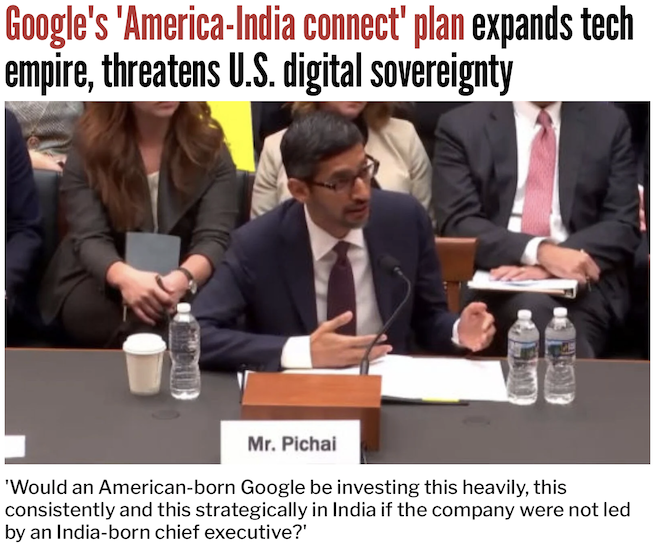
A fair question now hangs over Google’s latest U.S.-to-India fiber move: Would an American-born Google be investing this heavily, this consistently and this strategically in India if the company were not led by an India-born chief executive? No public record can prove motive. But the timeline is real and it is striking.
Sundar Pichai became Google’s CEO in August 2015 and later became Alphabet’s CEO in 2019, consolidating control over the company’s biggest strategic bets. See the official congressional biography noting his 2015 CEO appointment here: Congressional bio of Sundar Pichai.
From that point forward, Google’s India alignment moved from “important market” to “core platform,” with a sustained buildout across capital, cloud, cables, government programs and national talent pipelines.
Bartolotta continued:
At the India AI Impact Summit 2026, Pichai announced “America India Connect,” including a new India-U.S. subsea cable and wider connectivity initiatives tied to AI scale.
At the same time, India’s talent pipeline institutions are being plugged into Google-branded skilling and internship ecosystems. For example, AICTE and EduSkills list Google tracks such as “Google AI ML” as part of their virtual internship offerings. See EduSkills’ program page: AICTE EduSkills virtual internships.
The Confederation of India Industry (CII) has hosted formal education and capacity building programming with Google for Education, reflecting the kind of industry body alignment that helps normalize policy friendly partnerships and workforce pipelines. Put plainly, this is how a multinational moves from selling products into a country to embedding itself into that country’s industrial policy, skilling apparatus and digital infrastructure.
Again, there is no public document that says, “Google is doing this because its CEO is Indian-born.” But there is also no denying the pattern.
[…]For Americans watching Big Tech’s loyalty drift from domestic priorities toward foreign-aligned infrastructure strategies, the question is no longer fringe. It is rational. If the next decade’s AI economy runs on data centers, cables and labor pipelines, then the center of gravity matters.
And Google is very clearly helping move that center of gravity toward India.
And there is no denying the fact that Bartolotta turned racist on this issue because it suits her agenda to do so — she clearly believes that swarthy brown people shouldn’t have any role in managing the internet, which is apparently a job only for Americans. Unsurprisingly, she gives neither Pichai nor anyone else at Google an opportunity to respond.