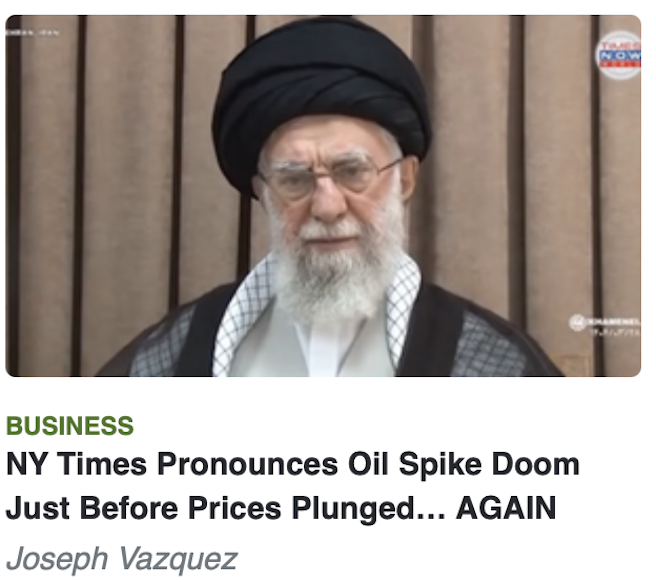
The Media Research Center’s Joseph Vazquez did his best to try and spin rising oil prices due to President Trump’s attack on Iran in a March 9 post:
The New York Times was apparently so eager for an economic win to skewer President Donald Trump’s military achievements in Iran that it ended up making itself look foolish. As the saying goes: Curb your enthusiasm!
“Oil Prices Spike Over $110 a Barrel, Highest Since Pandemic,” read the March 8 headline from Times reporters Rebecca F. Elliott and Joe Rennison. Of course, zeroing on the “since the pandemic” angle allowed Elliott and Rennison to avoid mentioning President Joe Biden’s name at all, when Brent crude oil spiked to $119 a barrel June 6, 2022, and when gas prices surged to the highest average on record at over $5 June 14, 2022. And guess what: That happened without the U.S. leading a joint international effort to finally topple an entire, bloodthirsty regime.
But Elliot and Rennison railed that the brief oil market shock was a “sign of growing concern that” the successful mission to cut the head off the “Death to America” snake in Tehran “will continue to take a toll on energy supplies, raising gas prices for American consumers and weighing on the stock market.”
Here’s the problem: That narrative just had an hours-long shelf life. Both West Texas Intermediate (U.S.) and Brent crude oil prices (global) fell under $100 as finance ministers from G-7 countries discussed releasing up to 400 million barrels of oil. WTI Crude plunged as far as beneath $92.50 barrel after peaking over $119 early Monday morning. As popular economics-focused social media account Geiger Capital wrote in an X post around noon, “Oil is now in a bear market… Down -20% from [its] recent highs.” Industrial commentary company The Kobeissi Letter contextualized around 6:00 am that this complete 180-degree turnaround was reflective of “one of the biggest daily crude oil reversals in history.”
Vazquez inserts tweets supporting this from something called the Kobeissi Letter, which was founded by a guy who, according to one observer, has “a grand total of 28 months of relevant work experience in a second/third-tier investment bank,” which results in content that is “often low-quality and misleading.”
Still, Vazquez returned for more of the same in a March 17 post:
Someone should do a wellness check on The New York Times. Looks like its journos read the portents wrong — AGAIN — on another one of its apocalyptic prognostications on the economic consequences of President Donald Trump taking out the Islamist regime in Iran.
Times business reporter Emmett Lindner nonsensically tried to dig up the corpse of the 1970s oil price shock following the Yom Kippur War as a comparative case study to what is transpiring around the Persian Gulf as Israel and the U.S. decimate Iran’s war machine. “Echoes of the ’70s in What’s Now the Largest Oil Shock Ever,” read Lindner’s overdramatic March 13 headline.
Lindner even had the temerity to suggest that the Iran War of 2026 was “worse” than the 1973-74 energy crisis, which was marked by a plethora of factors, which included the following: Bad domestic policy, dollar devaluation, and an oil embargo imposed by the Organization of Arab Petroleum Exporting Countries (OAPEC).
“Certainly, oil and gasoline prices are soaring,” cried Lindner like a soothsayer throwing fits as he pours over the portents. “The 1973 embargoed oil accounted for about 7 percent of global oil consumption, and targeted only a handful of nations … Now, closer to 20 percent of the world’s supply is threatened, and the disruption is caused by a war that has no end in sight.”
Lindner’s scareporn had a shelf life of about 3 days, as U.S. oil prices (WTI crude) would plummet over five percent back under $100 to $93.54, leading Wall Street toward having its best day since the war began, as the Associated Press reported March 16. As popular trading account NoLimitGains posted on X the same day, “Traders are betting this [war] ends soon.”
Vazquez didn’t mention that NoLimitGains has been accused of fraud, which would undercut his touting of the account. He also didn’t mention that crude oil prices were around $70 before the start of Trump’s war, making his claims that oil prices had “plummeted” relative at best and highly dishonest at worst.
Vazquez was at it again in a March 20 post:
Apparently the most important positive outcome from the war with Iran is that it has the potential to reduce the world’s reliance on fossil fuels according to Gaia’s acolytes at Reuters, not knocking out the world’s foremost state sponsor of terror.
“Iran war energy shock sparks global push to reduce fossil fuel dependence,”celebrated Anna Hirtenstein and Kate Abnett on March 18.
The Reuters duo wrote policy makers are “rethinking ways to reduce long-term dependence on oil and gas imports, with proposals to expand nuclear energy and renewables, grow strategic stockpiles and domestic production, and diversify foreign sources of supply.”
Vazquez then ranted that Trump engaged in “anti-climate” rhetoric, “as if President Donald Trump opposes the weather or something.” As Vazquez almost surely knows, weather is not climate.