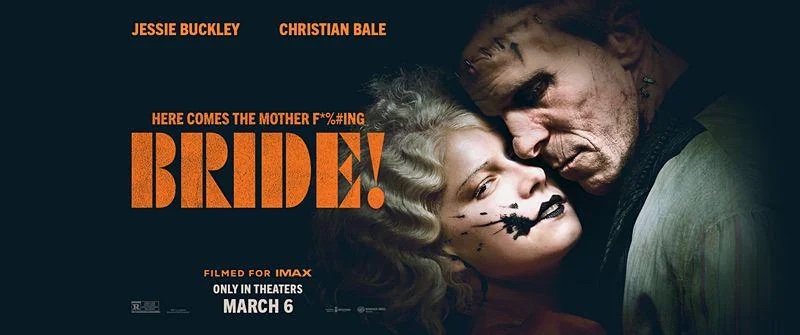
James Hirsen spent his March 12 Newsmax column blithely dismissing a film he didn’t like:
In the risky business that is Hollywood, where budgets frequently reach nine figures and a film’s fate is determined by the willingness of film-goers to part with their dollars, Warner Bros.’ “The Bride!” is serving as the perfect cautionary tale on how ill-advised it is to mix woke politics with general entertainment fare.
Written and directed by actress-filmmaker Maggie Gyllenhaal, a movie that’s supposed to reimage the “Bride of Frankenstein” film has only managed to scrape together a minuscule $7 million domestically during its recent debut weekend.
Because it has a humongous $90 million production budget hanging over it, the project is on track to lose north of $100 million, once marketing and distribution are factored in.
This was no misfire, but rather a full-blown box-office disaster, joining the ranks of other infamous flops that have hemorrhaged cash while favoring cultural relevance over entertainment.
But why did this star-studded vehicle, which features an Academy Award winner and two Oscar nominees, fail so spectacularly?
The answer lies in the film’s heavy-handed injection of a political agenda, which transforms what could have been a respectable remake of a horror classic into a hack D-level flick.
[…]Subtlety is abandoned and the movie quickly degenerates into a lengthy diatribe, with multiple scenes being devoted to chastising the viewing audience.
Folks are not inclined to spend their time and/or money on a film that feels as if they’ve been corralled into participating in a feminist studies seminar.
Entertainment, yes. Escapism, yes. Sanctimony, a definite no.
Actually, Variety offered five reasons the film failed at the box office — none of which have anything to do with the message Hirsen alleges it has, and the main one being that it was released in March instead of around Halloween.
But Hirsen wasn’t done whining:
“The Bride!” is no isolated agenda-ridden film.
It’s the latest in a string of politically charged missteps that have alienated mainstream viewers and consequently tanked at the box office.
Disney’s “Star Wars” sequels stand as the granddaddy of such disasters, illustrating how sermonizing over storytelling swiftly alienates audiences, leading to both losses in revenue and long-term damage to brands.
The “Star Wars” sequels feature content in which diversity and girlboss tropes overshadow coherent plots. They, along with Marvel’s recent offerings, favor identity politics to a such a degree that a billion-dollar franchise has now become damaged goods.
Hirsen didn’t explain how being diverse is suddenly a bad thing for movies.