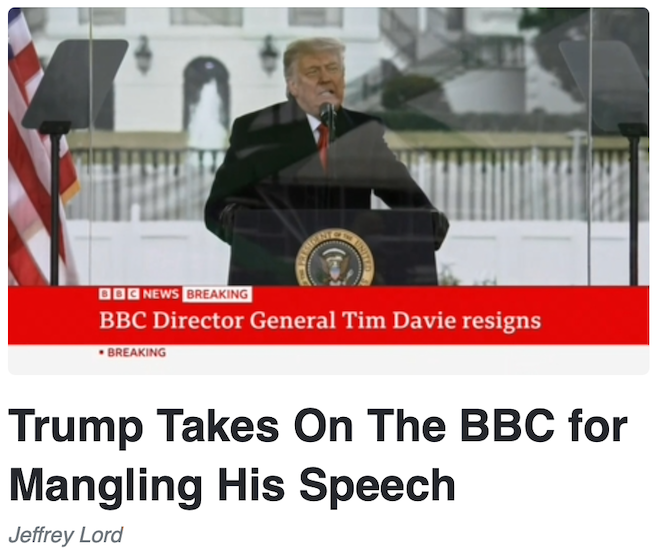
The Media Research Center raged at the BBC for portraying Donald Trump as encouraging the Capitol riot in a speech beforehand, and it continued to do so. Jorge Bonilla huffed in a Nov. 11 post that non-right-wing media didn’t cover the story and that CBS did only a 20-second brief on it:
The Elitist Media seem to have been made very uncomfortable by the recent resignations of two BBC executives, after outrage over a documentary that aired manipulated video of President Donald Trump’s speech at The Ellipse on January 6th, 2021. So much so, that they barely covered the scandal, if at all.
The only network evening newscast to cover the scandal was the CBS Evening News. To be clear, “cover” is doing a herculean lift here.
[…]You will notice that the brief is framed around President Trump’s litigation threat and demand for retraction, respectively. But there is nothing between those frames to enlighten the viewer as to why Trump might want to sue or demand a retraction.
Likewise, there is no insight as to HOW the documentary suggested that Trump called for violence on January 6th, which is patently false.
[…]President Trump’s full quote was that he would walk with supporters “to peacefully and patriotically make your voices heard.” But the BBC’s segment made the president “‘Say’ things [he] never actually said,” by editing together footage from the start of the speech with a separate quote nearly an hour later, according to the leaked dossier.
None of that made it to the CBS Evening News. CBS’s brief was a classic Trumpwash: when Donald Trump’s reaction to a scandal is reported as the actual scandal, thus giving Elitist Media outlets the cover to omit the details that made the scandal a scandal in the first place.
But Bonilla is trying to pretend that Trump never told his audience to “fight like hell” or put it in the context he demands that other statements be put into.
Tim Graham spent part of his Nov. 11 podcast raging at the “fraudulent editing of Donald Trump’s speech to supporters on January 6, 2021 — not to mention the BBC’s horribly pro-Hamas coverage of the war in Gaza.” We’ve documented how that Gaza study, which made heavy use of the kind of artificial intelligence the MRC normally disdains, was found to be highly flawed with a researcher bringing a pro-Israel bias to the project.
Alex Christy complained in a Nov. 15 post:
As President Trump prepares to sue the BBC for deceptively editing his words on January 6, 2021, to make it appear like he urged violence, PBS’s Christiane Amanpour said on her Friday podcast, The Ex Files, that the idea that the BBC is biased is “probably wrong” and that her own network is “an absolute must” have for the American people.
[…]Amanpour’s ode to the BBC continued, “It does politics from one end of the spectrum to the other. It does sports, entertainment. All of that. David Attenborough, you know, the great naturalist who brought everybody the world and made the world fall in love with wildlife. Thank you to the BBC. So, I do think that one has to be super careful. Why not just, you know, say when you’re wrong, make a correction, but the idea of institutional bias at the BBC, I think, is probably wrong.”
In 2025, you do not need a public broadcasting network to get sports and entertainment.
Christy also hauled out the bogus study of the BBC’s coverage of Israel and Gaza, insisting it was “one journalistic scandal after another.”
The same day, Jeffrey Lord spent a column insisting that “a ‘stunt’ is decidedly not what Trump is about” — has he never observed Trump in action? — before lecturing:
There is a reason that in today’s world news outlets from Newsmax to Fox News to so many conservative others, both in print and broadcast form, exist in the first place.
And that reason is simply that as more and more Americans of the long ago began to wake up to the fact that the nation’s major newspapers and television news outlets – The New York Times, Washington Post and the major television broadcast networks of the day (among others) were decidedly not straight “just the facts” journalism as they were advertised to be.
Will Trump’s taking on the BBC set some sort of a pattern of caution down the media road for theoretically non-partisan outlets to actually live up to their self-appointed image as non-partisan “just the facts” journalism?
Who knows? But the very fact that Trump has set this type of response in motion by legally taking on the BBC with his potential BBC lawsuit is something new.
Stay tuned.
We won’t bother to stay tuned whether Lord puts Trump’s “fight like hell” remark in its proper context.