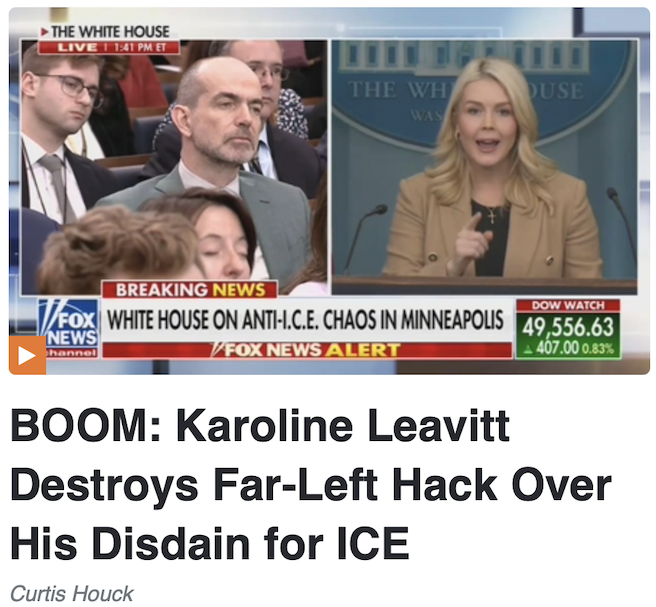
It’s been a while since we looked in on Media Research Center writer Curtis Houck’s fawning over White House press secretary Karoline Leavitt. He didn’t disappoint in a Jan. 15 post:
Towards the end of Thursday’s fairly tepid White House press briefing, things took a dramatic turn when The Hill’s Niall Stanage told Press Secretary Karoline Leavitt that an Immigration Customs and Enforcement (ICE) officer “acted recklessly and killed” Minnesota resident Renee Good “unjustifiably” and thus there was no way ICE does “everything correctly.”
Thankfully, Leavitt promptly shoved this partisan tool into a rhetorical locker. The initial question was hostile decrying ICE tactics since “170 U.S. citizens were detained by ICE” last year, but Stanage really stepped in it when Leavitt asked him “why…Good unfortunately and tragically killed” [.] […]
“So, you’re a biased reporter with a left-wing opinion? Yeah, because you’re a left-wing hack. You’re not a reporter. You’re posing in this room as a journalist…[Y]ou shouldn’t even be sitting in that seat, but you’re pretending that you’re a journalist,” Leavitt replied.
Stanage repeatedly insisted she explain to him “what was inaccurate in what I said,” but Leavitt schooled him on his lack of interest in the illegal aliens with lengthy and dangerous records being taken off the streets by ICE.
“I bet you didn’t even read up on those stories. I bet you never even read about Laken Riley or Jocelyn Nungaray, or all of the innocent Americans who were killed at the hands of illegal aliens in this country,” Leavitt added in part.
Stanage has long been a political hack. Taking a trip back into the NewsBusters archives, Stanage went on MSNBC and marveled at a book excerpt for Hillary Clinton’s What Happened as proof of her “talk[ing] about [2016] in her own voice” and “we’re not used to that…blood and guts”
Houck made sure to avoid the fact that Leavitt’s tirade was all about avoiding having to answer Stanage’s question about Good, because it does appear that Good was killed for no reason. He did make sure, however, to point out that “on the conservative reporters front, our friend Reagan Reese of the Daily Caller wondered what further devolution inside Minneapolis would have to occur for President Trump to follow through on his threat to invoke the Insurrection Act,” adding that “Daily Wire White House correspondent and MRC Bulldog Award winner Mary Margaret Olohan was also there, asking Leavitt to speak to the anti-ICE rhetoric from the left.” He also noted that “Daily Signal’s Elizabeth Mitchell closed out the Q&A with two questions, one of which touched on an embarrassing display by a woke doctor at a Senate hearing this week.”
Jeffrey Lord weighed in on this exchange as well in his Jan. 17 column, contrasting Stanage’s actions with that of another reporter for The Hill, May Craig, a “journalist’s journalist” who was “respectful” and “polite”:
Craig was respectful and neutral in tone and substance. Stanage was seriously partisan, not to mention outright rude.
Which goes to a much larger point. Too many people covering the Trump White House, whether in the White House or spread across the media around the country, are not about journalism. They are about left-wing, anti-Trump activism — exactly as Leavitt said.
Just one of the problems with this is that down the road, when Trump is long gone from the White House and a Democrat holds the Oval Office, the ground has been laid for right-wing activists to also masquerade as journalists covering the Democrat President and his/her administration.
Which is to say, the old wisdom applies: “Be careful what you wish for.”
And if and when the day arrives that the White House press room is filled with conservative activists masquerading as journalists, you will know where they got the idea.
Actually, as Houck demonstrated, the White House briefing room does contain conservative activists. Lord simply pretends that they don’t exist — and that asking a critical question of a Republican administration is the same thing as “left-wing activism.” Lord also failed to explain what, exactly, was “rude” about Stanage’s question.