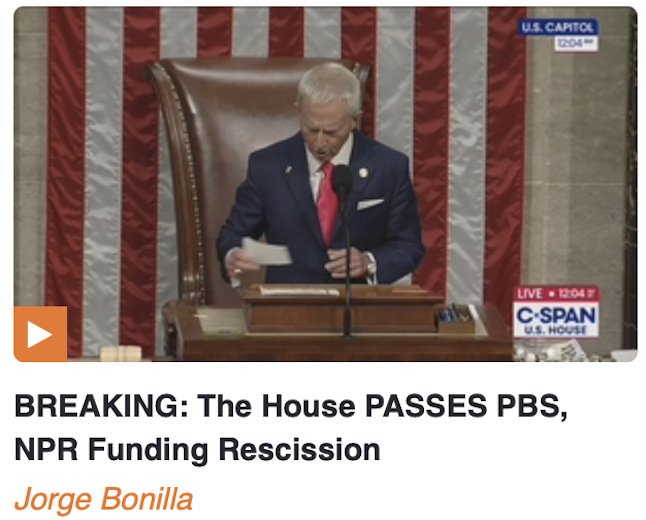
The Media Research Center has spent all year cheerleading for the Trump administration to defund public broadcasting because it’s not right-wing enough. It ultimately got its wish, and Jorge Bonilla gushed in an early-morning July 18 post:
In a midnight vote, the House of Representatives voted to approve the rescission package that passed the Senate 22 hours before, effectively DEFUNDING liberal propaganda outlets PBS and NPR. The rescission now heads to the Resolute Desk for signature by President Donald Trump.
[…]Finished, indeed. A rescission 38 years in the making.
Bonilla then touted how his new boss, nepo-baby David Bozell, cheered the vote as well as included a NewsBusters tweet that was even more gushy: “After 38 years of fighting PBS and NPR’s bias, President Trump’s rescission package to defund PBS and NPR is officially passed!” in which it proved yet again that it was all about partisanship.
That was followed by a post from Curtis Houck whining that non-right-wing media weren’t sufficiently covering the defunding so it could rejoice in their misery:
Despite the fact that their political correspondents were consumed by suddenly being concerned with a president’s health and their gleeful Epstein coverage, one would have thought ABC, CBS, and NBC could have still found time to go full Chicken Little about the House’s final passage of the $9 billion rescissions package that included a $1 billion clawback of funding to far-left PBS and NPR.
But, alas, they more or less whistled past the graveyard and moved on, spending only a combined one minute and 48 seconds on the vote to defund PBS and NPR, a battle the left had won for nearly 60 years while we at the Media Research Center emerged as the victor in this multi-generational war. As we’ll see, however, the real number was more like 94 seconds.
Houck didn’t explain why his employer’s censorship scheme is considered a “victory” or explain how, exactly, public broadcasting is “far-left.”
In another post that day, intern Matthew Seck complained that “MSNBC’s Jen Psaki made biased and flat out false claims in the lead up to the recent passing of HR 4 by the Senate early Thursday morning, during The Briefing. Psaki and her guest, Arizona Senator Mark Kelly (D), tried their best to argue against the cutting of taxpayer funding to PBS and NPR by omitting key details.”
Clay Waters did his own whining in a July 19 post:
New York Times columnist and the allegedly conservative half of PBS News Hour’s weekly Friday news recap, David Brooks, unleashed an unintentionally hilarious counterargument to Congress’s decision earlier in the week to rescind federal funding for the Corporation for Public Broadcasting. According to Brooks, not only is PBS not on the left, but it also provides local news to the state of Maine.
[…]The insinuation that if it weren’t for public broadcasting, Maine would be like some untouched tribe without the benefits of modern media is as hilarious as it is offensive. The Portland, Bangor, and Presque Isle markets all have private TV and radio options.
Brooks also lamented that anyone would associate PBS with the left, “And I should say perceived left. It’s not always that the institutions they think are left are left. And anybody who doesn’t agree with them is left. And so they’re having their way.”
If a news organization is 27 times more likely to describe something as “far-right” than “far-left,” covers the Republican National Convention with 72 percent negativity compared to the Democratic National Convention at 88 percent positivity, and who’s “conservative” commentator voted for Barack Obama and still sounds like a liberal, then what is that if not a liberal outlet?
Yet Waters and the rest of his MRC colleagues rarely admit the explicit bias of Fox News and other right-wing media.
Waters whined further in a post later in the day:
Amid the predictable wailing over the House vote to claw back $1 billion of taxpayer funding from hopelessly biased public media outlets PBS and NPR, one news outlet was unusually bitter: The Wrap, an L.A.-based news site focused on the entertainment business, which seemed to take the cuts as a personal affront, and in the process proved it resides in a West Coast liberal bubble. (Seriously, Bluesky?)
Of course, the MRC’s drive to defund public broadcasting is all about personal partisanship, not principles.
Tim Graham crowed in a July 19 “victory lap” podcast:
The defunding on PBS and NPR finally happened, something the MRC has been advocating for decades. MRC President David Bozell and Managing Editor Curtis Houck reflect on all the lame liberal arguments and the questionable future for these networks.
Start with the lame old argument about killing Big Bird — which has been an outdated argument since HBO took over Sesame Street in 2015 (and it’s now on Netflix). The Democrats always want to pretend this is about children’s television, not the horrible bias shown to adults in the evenings. The CEOs of PBS and NPR ridiculously claim they just haven’t seen any evidence of that bias, like they’re blind and deaf. They prepared with lawyers on how to testify before Congress, and each decided that sounding stupid and clueless about bias was the smartest strategy.
We keep unloading our studies of their content. Most recently, we noted NPR’s Fresh Air has featured long interviews with 36 liberal journalists in the first six months of 2025, and exactly zero conservative journalists. The live prime-time PBS coverage of the 2024 party conventions was the latest Exhibit A of partisanship in an election year. PBS “treated” the RNC to 72% negative and 28% positive commentary. The DNC received a publicist’s reception: 12% negative, 88% positive.
Defunding PBS and NPR forces them to contend in the marketplace, which is a much different world than it was when this all started in 1967, or in 1997. Nielsen’s research on TV use found streaming captured 44.8 percent of viewing time in the United States for May, beating the combined tally of 44.2 percent for cable (24.1 percent) and broadcast (20.1 percent). Many Americans born after 1990 don’t even watch network television or radio. They’re beginning to look antiquated.
During the entire defunding battle, NPR and PBS used their own airwaves and websites and social-media accounts and direct-mail fundraising lists to lobby their supporters to inundate members of Congress to “Protect My Public Media.” They didn’t allow the MRC or any other conservatives to discuss their blatant biases on their own shows.
The MRC doesn’t allow anyone to rebut its shoddy research on its network of websites, even though it receives government benefits in the form of nonprofit tax breaks, so Graham’s complaint rings hollow and hypocritical.