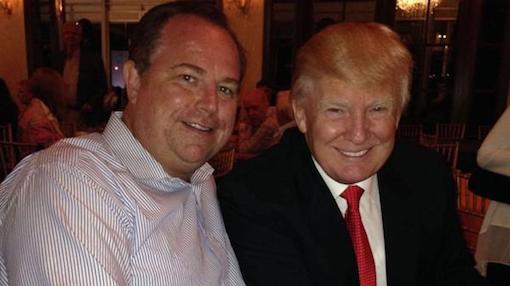
Christopher Ruddy continued his streak of fawning over President Trump with a March 10 column gushing over his bombing of Iran:
In just over a week, something remarkable has happened in the Middle East.
The war with Iran — feared by many for decades — has largely been decided.
President Donald Trump, working closely with America’s ally Israel, has already achieved what many believed would require months of combat or might never happen at all.
Indeed the world has witnessed the near-total destruction of Iran’s military infrastructure and the dismantling of its nuclear ambitions.
That is why I believe history will record this moment clearly: Trump has “won” the war. Now he will soon win the peace.
In fact, Trump’s war is still going on, which means Iran’s military has not been as destroyed as Ruddy insists. But Ruddy continued to gush:
That lesson is clear: sometimes the cost of inaction is far greater than the cost of action.
Trump chose action.
By dismantling Iran’s nuclear infrastructure and crippling its military capabilities, he has lifted a nuclear cloud that hung over not only Israel but also for America’s partners in the Gulf.
[…]For decades previous presidents had kicked the Iran can down the road, so to speak.
But, in a matter of days President Trump confronted one of the most dangerous nuclear threats in the world and removed it.
That was not hesitation.
That was not incremental diplomacy.
It was a decisive act of leadership.
And it should go down as one of the most consequential — and courageous — foreign policy decisions of our time.
Ruddy followed up with an April 16 column not only insisting again that Trump won the war, he won nine separate battles in the process:
The first and most central objective of the war, as articulated by Trump, his advisers, and Prime Minister Benjamin Netanyahu, was to stop Iran from building such a weapon and to destroy its nuclear program.
By all accounts, that goal was accomplished with remarkable speed.
[…]The second pillar of Trump’s victory rests on the broader dismantling of Iran as a regional military power.
[…]Third, Trump’s actions have ushered in a new, de facto Arab-Israeli alliance as key Gulf states see their future tied to Washington and Jerusalem.
The Abraham Accords, once criticized as largely symbolic, have taken on a new reality as shared security concerns have brought Israel and Sunni Arab states into close alignment.
[…]Fourth, Trump’s decisive stand against Iran has, in the long term, weakened Iran’s proxy network, which has disrupted the region for years.
[…]Fifth, Trump’s actions against Iran will ultimately strengthen NATO by forcing a reckoning among its members.
[…]Sixth, China emerges in this framework as a strategic loser, despite not being directly involved in the conflict.
[…]Seventh, Russia’s position has been weakened as well.
Although Moscow has profited in the short term from sanctions relief and high oil prices, these are only temporary benefits.
[…]Eighth, Trump is right when he says that stabilizing the Gulf and reopening energy flows will ultimately benefit global markets and the world economy.
[…]Ninth, the Iran conflict could make the United States stronger and better prepared for future wars.
Clearly, this conflict has provided what military planners often call “lessons learned” for future engagements.
Ruddy concluded:
These nine Trump “wins” are not the final list, but just the most apparent as of today.
Trump’s decisiveness and strategic approach in handling this crisis stands in sharp contrast to President George W. Bush’s approach in handling the Iraq War.
Where Iraq and Afghanistan became prolonged and costly occupations — literally quagmires —Trump’s engagement would be shorter, more targeted, and limited in scope and result in economic and security benefits.
Importantly, Trump will avoid large-scale troop deployments and the likely casualties that follow.
Again, the war is still going on — something Ruddy hasn’t accounted for in his Trump-fluffing.