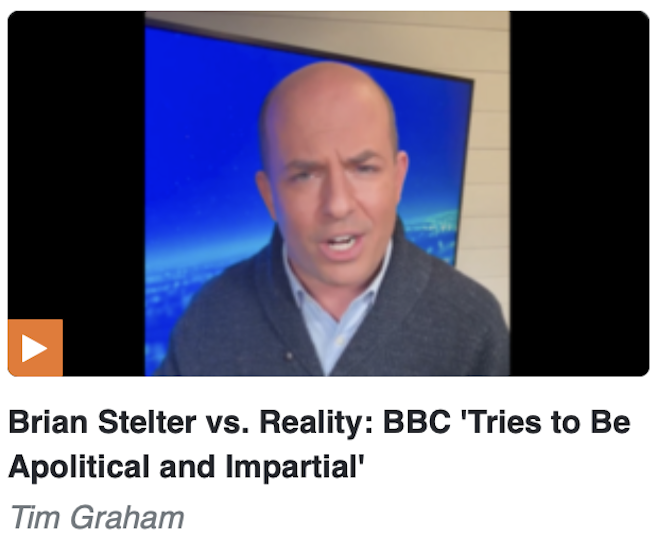
The Media Research Center’s serious case of Stelter Derangement Syndrome continued unabated at the end of last year. Tim Graham weighed in on Stelter’s take on the controversy between President Trump and the BBC in a Nov. 10 post:
Leftists like CNN’s chief media analyst Brian Stelter feel terrible about two top executives at the British Broadcasting Corporation (BBC) tendering their resignations over a really bad edit of Donald Trump’s speech to supporters on January 6, 2021. Those right-wingers are ruining things again by focusing on aggressive media mangling of the facts.
In a video on X, Stelter lamented that this edit shouldn’t have forced resignations, but the BBC “exists in an incredibly politically charged environment, even as it tries to be apolitical and impartial.” Wrong. Nobody believes they’re “trying” to be apolitical. They want to be perceived as impartial even as they’re extremely partial.
As Stelter notes, the BBC has faced relentless criticism over its relentless bias against Israel and in favor of Hamas in its reporting from Gaza.
[…]The lefties are also concerned about the re-evaluation of the BBC’s license-fee system of funding “public” media. British households pay £174.50 ($230) a year for BBC shows and services, which leads to conservative complaints about involuntarily supporting anti-conservative media.
No one probably fears for the BBC under a Labour Party government, but the BBC’s brand is definitely struggling, just like aggressive bias caused a funding problem for PBS and NPR.
Two days later, it was Jorge Bonilla’s turn to grouse about Stelter and the BBC:
PBS News Hour did an extended segment on the crisis currently roiling the British Broadcasting Corporation (BBC) over its grotesque edit of President Trump’s speech at The Ellipse on January 6th, 2021. This could have been an opportunity for reflection on what ails the media in this environment, and on the dangers of having Trump Derangement Syndrome infect editorial choices. Instead, we got seven-plus minutes of Brian Stelter doing damage control for the Beeb.
Anchor Geoff Bennett served here as an appliance more than as an interviewer. This was clearly Stelter’s segment- a platform for unchecked “context” and “nuance” on what the resignations at the BBC really mean, as opposed to a giant scandal brought forth by unfettered systemic media bias.
[…]Here, as Stelter has done often throughout this BBC cycle, is the diminishment and isolation of the actual video splicing. Stelter frames it as a giant but narrow mistake that doesn’t obscure the broader meaning of Trump’s words and deeds on January 6th. In sum, Stelter is pleading “fake but accurate” on behalf of the BBC. But as I often tell people, deliberate actions are not “mistakes.” Splicing two video segments nearly an hour apart is not a “mistake”, but an intentional editorial decision. And someone who spent the pandemic and recovery arguing for censorship (“freedom of speech but not freedom of reach”, anyone?) should know better. The idea that the edit wasn’t “malicious”, as Stelter says earlier in the interview, is patently offensive.
As before, Bonilla failed to explain the context of Trump’s “fight like hell” remark during his speech, let alone explain why that should not be considered the speech’s dominant theme. Instead, he whined that “The whole exercise was designed to exculpate the BBC for their willful transgressions.”
Nicholas Fondacaro complained about Stelter’s critique of Trump’s lawsuit against the BBC, while also playing whataboutism, in a Dec. 17 post:
Earlier this week, President Trump filed a $10 billion defamation suit against the BBC alleging that they deceptively edited his speech from January 6, 2021 to omit his call for the a peaceful protest; something the BBC seemed to cop to in an apology they issued in November. The fresh suit caused CNN chief media analyst Brian Stelter to clutch his pearls during a Tuesday edition of CNN News Central, where he suggested the suit was about chilling speech. He was wrong. The suits we’ve seen in recent years were to hold the media accountable, and save them from themselves.
“Number one, a year ago it was unheard of for a sitting American president to file a lawsuit against a news outlet. This never happened before until President Trump returned to office for his second term,” Stelter warned. “But now, this year, he has sued The Wall Street Journal, The New York Times, and as of this morning, the BBC. So, he is charting a new course, trying to take his war against the news media to court.”
Of course, Stelter conveniently ignored how the Obama Justice Department had targeted individual journalists and tried to lock them up: James Rosen (Fox News at the time) and James Risen (The New York Times at the time).
Fondacaro didn’t explain why he keeps citing alleged abuses under the Biden administration to justify actual abuses by Trump. He went on to grouse that Stelter pointed out that Trump filed his lawsuit against the BBC in Florida:
Despite of Stelter’s insistence that the case didn’t have standing in Florida, it arguably did for the same reasons the case against CNN was filed there. The BBC documentary was available online and viewable in Florida. Then there’s also the fact that Florida was Trump’s official residence (much like how Navy veteran Zachary Young’s business, Nemex was incorporated in Florida).
Stelter was right that a president had never taken the media to court so many times. But we’ve also not seen so many private citizens do the same until recent years.
Brian, maybe it’s because the media had never been more radical and reckless with their reporting. Since Trump first became president, the media had grown more vicious and zealous in their perceived moral superiority (a dangerous combo); seeing themselves as paladins wielding their pens like swords against what they’ve openly claimed was an “existential threat” to the country and existence.
It’s the reason they felt comfortable in targeting and smearing children like Nick Sandmann and 9-year-old Chiefs fan Holden Armenta. Also this year, just days before it went to trial, MSNBC had to settle their own defamation suit for erroneously dubbing a doctor the “uterus collector” because his had seen illegal immigrant women in ICE’s custody.
Conspicuously absent from Fondacaro’s list of media missteps: Fox News falsely smearing Dominion with bogus charges of election fraud, for which Fox News ultimately agreed to pay Dominion $787 million.
Fondacaro closed by complaining that Stelter once called out Fox News: “Stelter was all for calling out what he saw as misinformation, like calling his efforts to put Fox News out of business “harm reduction”; but when it was about holding the leftist media to account for their misinformation, he condemned it.” Given Fox’s lies about Dominion, Fondacaro didn’t explain why Stelter’s case against Fox News is in any way inaccurate.